Nethy Bridge Residents Welcome Return Home Following Ten-Day Wildfire Crisis
Wanderstayfinder.com – Locals in the remote Scottish village of Nethy Bridge have received official permission to resume their daily lives after a massive wildfire finally began to recede from their doorstep. The extensive blaze, which has been burning within the boundaries of the Cairngorms national park for ten consecutive days, had necessitated the complete evacuation of the settlement. Authorities confirmed that the immediate danger has passed, allowing families to return to properties they had abandoned just days earlier.
Official Recognition of Community Resilience
Superintendent Judy Hill from Police Scotland expressed profound gratitude to everyone involved in containing the flames. She highlighted the collaborative effort that spanned multiple agencies and local volunteers. The combined work of dedicated fire crews, experienced gamekeepers, construction contractors, and numerous partner organizations over the previous twenty-four hours proved decisive. This collective action eliminated the urgent threat that had originally triggered the mass evacuation of homes throughout Nethy Bridge.
“We are grateful to the community for their support and understanding in what has been a period of concern and disruption.”
Supt Hill emphasized that the cooperation shown by local residents during this challenging timeframe was instrumental in managing the crisis effectively.
Government Response and Military Support
Scotland’s First Minister, John Swinney, publicly acknowledged the successful containment efforts and praised the dedication of emergency personnel. He noted that fluctuating weather patterns throughout the ten-day period had created unpredictable conditions for those battling the flames on the ground. His comments highlighted both the difficulties faced and the remarkable perseverance demonstrated by all involved.
“Efforts to tackle the wildfire in the Cairngorms are in their 10th day, and changeable weather conditions have presented a range of challenges for those on the ground. I praise their resilience and tireless efforts to bring it under control.”
Following the decision to allow residents back into Nethy Bridge, Police Scotland officially withdrew the major incident declaration that had been in place. However, Swinney cautioned that complete safety had not yet been achieved. He assured the public that the Scottish government, alongside emergency services and all relevant authorities, would maintain full vigilance until every remaining ember was extinguished.
Earlier on Saturday, the First Minister had formally requested military assistance from the UK government. This support came as more than five hundred firefighters worked alongside specialized wildfire vehicles, all-terrain rescue machines, and helicopter units conducting water-bombing operations. Partner agencies also contributed significantly to the comprehensive response effort.
The Human Impact of the Evacuation
During the evacuation, local residents were transported to a specially arranged respite center located at the Macdonald Aviemore hotel. Road access to the village had been restricted due to growing concerns that the advancing fire might reach the settlement. The all-clear was finally given just before eleven o’clock on Saturday evening.
Claire Montague, a sixty-five-year-old retired general practitioner, shared her personal experience with the unfolding disaster. She and her family had been forced to leave their home on Friday as conditions deteriorated rapidly. Montague described watching smoke billow into the sky and seeing flames dance on the horizon when the wind shifted direction. Despite the fire remaining several kilometers distant, she found the experience deeply unsettling.
“We could see the smoke rising and when the wind changed direction we could see the flames – it was pretty scary and felt pretty close although it was still a few kilometres away.”
Upon returning to check on their property, Montague observed enormous quantities of smoke emanating from the affected region. She noted that the situation remained far from resolved, describing the experience as absolutely terrifying and unlike anything she had previously encountered. She compared it to the Dava Moor fire from the previous summer, which had been located further from their residence.
“Thankfully they have managed to put in a firebreak.”
Montague also expressed concern for the ecological significance of the burned area. She explained that the fire originated in what was once the original Caledonian forest, an ecosystem of critical importance that conservationists had been working diligently to protect and expand. The creation of the firebreak required extensive bulldozing of the land, a development she found deeply sorrowful.
Ongoing Operations and Regional Warnings
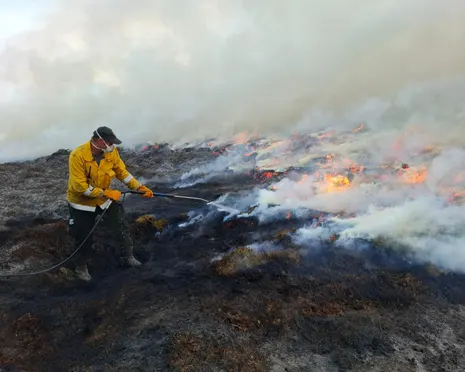
The wildfire initially ignited near the village of Glenmore on July 15, prompting the evacuation of both permanent residents and campsite visitors. At its peak intensity, the blaze consumed approximately six square kilometers, equivalent to 2.3 square miles, of heather-covered terrain and young trees. The smoke plume was so substantial that it drifted as far as Aberdeen, located roughly sixty miles or 97 kilometers from the fire’s origin point.
Senior officials from emergency services reported that firefighters continued their operations across the vast and difficult terrain. They worked in close coordination with Forestry and Land Scotland, the Cairngorms national park authority, private landowners, estate gamekeepers, and various emergency service partners. Officials credited the specialized expertise, local knowledge, and unwavering support of these groups as essential factors in managing this complex and ever-changing incident.
Meanwhile, the Scottish Fire and Rescue Service issued specific guidance to residents in Tomintoul, a community situated approximately ten miles or 16 kilometers to the east of Nethy Bridge. Authorities advised locals to keep windows and doors sealed to minimize smoke infiltration into their homes as the situation continued to develop.
“The wildfire, which broke out near the village of Glenmore on 15 July, led to residents and campsites being evacuated. It covered an area of about 6 sq km (2.3 sq miles) of heather and small trees at its height and its smoke drifted as far as Aberdeen, about 60 miles (97km) from where the fire started.”
Related Reading
Frequently Asked Questions
What is Evacuated villagers in Cairngorms allowed home?
Evacuated villagers in Cairngorms allowed home is the main topic of this guide. The article explains the context, practical details, and next steps readers should understand.
Why does Evacuated villagers in Cairngorms allowed home matter?
Evacuated villagers in Cairngorms allowed home matters because readers are looking for a useful answer, not just a short summary. Good content should match search intent and help them decide what to do next.