Mass Youth Uprising Challenges Delhi’s Political Establishment
A New Generation Rises Against Educational Failures
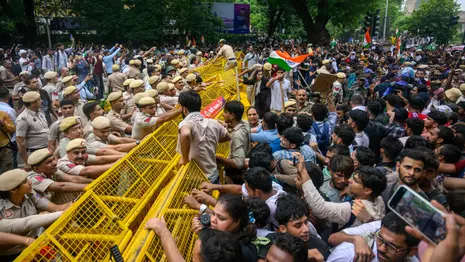
Wanderstayfinder.com – In a remarkable display of civic courage, tens of thousands of demonstrators converged upon India’s capital city, openly defying official police directives to voice their grievances against the ruling administration. This gathering stands as one of the most significant anti-government rallies witnessed in recent years, drawing participants predominantly from student communities and Generation Z demographics. The streets of Delhi resonated with passionate voices from the early hours of Monday, as crowds chanted slogans demanding accountability from political leaders.
The Cockroach Janta Party, a youth-driven organization that emerged from satirical origins, has transformed into a formidable political force. Founded by graduate Abhijeet Dipke during May, the movement adopted its distinctive name following comments made by India’s chief justice, Surya Kant, who referred to certain activists and jobless young citizens as “cockroaches.” What began as humorous commentary has evolved into a substantial challenge to Prime Minister Narendra Modi’s administration.
Central to the demonstrators’ demands is the immediate resignation of Education Minister Dharmendra Pradhan. This call stems from widespread chaos surrounding this year’s medical entrance examination, where over two million aspirants compete for merely 130,000 available positions. The examination was compromised by a significant leak that allowed the highest bidder to access questions in advance, ultimately forcing authorities to cancel the test and require students to retake the demanding assessment.
They are calling this protest illegal, they are calling us anti-national. But I am 22 years old and I am standing here to fight for our education system, for the rights of the young people and for our democracy. Is it too much to ask for the government to listen to us?
The consequences of this examination fiasco extend beyond academic disruption, with connections drawn to more than twenty tragic suicides among affected students. These incidents have amplified broader concerns regarding systemic educational failures and insufficient employment prospects for India’s burgeoning youth population.
Delhi police, operating under central government authority, had previously refused authorization for the march. Officials implemented comprehensive restrictions, including bans on public assemblies, road barricades throughout the metropolitan area, and an internet shutdown in the city center. Despite these measures, thousands of protesters persisted in their demonstration, many expressing vehement opposition to the Bharatiya Janata Party’s governance and its perceived neglect of younger citizens.
Harion Sharma, an eighteen-year-old participant who recently faced the challenge of retaking the compromised examination, described the emotional toll on students as “unbearable.” He emphasized that the examination leaks had directly contributed to student deaths, strengthening the protesters’ resolve to demand ministerial accountability.
This is a government that does not care about education, it does not care about the pressures and pain of young people. Because of those leaks, students have died. So we are here to call for accountability and for the education minister to resign. We are young but we are powerful.
Opposition leaders quickly condemned the heavy-handed police response. Priyanka Gandhi, representing the Congress party, questioned the appropriateness of deploying teargas against young demonstrators outside the parliament building, asking rhetorically what justification existed for such force against children.
For several weeks prior to the demonstration, government officials had largely overlooked CJP supporters who had established camps less than a mile from parliament. Minister Pradhan had previously characterized these protesters as “terrorists” in an attempt to dismiss their demands. However, the unprecedented turnout on Monday prompted the Modi administration to extend invitations to multiple CJP representatives for discussions.
CJP spokesperson Saurav Das reported that participants waited two hours before securing a brief audience with cabinet minister JP Nadda. According to Das, the government had yet to provide concrete commitments regarding the protesters’ concerns.
This demonstration occurs within a regional context where youth-led movements have successfully toppled governments in neighboring nations including Nepal, Bangladesh, and Sri Lanka. Such large-scale expressions of public dissent have become increasingly rare in India over recent years. The BJP, which has maintained power for twelve years under Modi’s leadership, has accumulated extraordinary influence at both national and state levels while frequently detaining and marginalizing critics.
Among ruling party members, MP Kangana Ranaut criticized the protest, asserting that external pressure cannot dictate governmental personnel decisions regarding ministerial appointments and dismissals.
As the CJP continues to grow in influence, its ability to mobilize young voters and sustain public attention on educational reform remains a critical factor in determining whether this movement will achieve lasting political transformation or fade into historical memory alongside other youth uprisings of the past decade.