US Military Says It Disabled Tanker Amid Iran Strikes
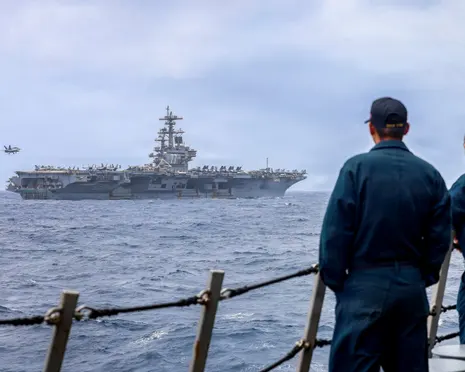
US military says it disabled tanker – US military says it disabled a tanker attempting to breach the American blockade in the Strait of Hormuz. United States Central Command announced that precision missile strikes hit the vessel’s smokestack, effectively stopping the commercial ship from reaching Kharg Island. The operation was part of a broader military campaign against Iran on July 15th, with official updates shared on social media platform X.
The targeted oil tanker, identified as the M/T Belma and registered under the Curacao flag, was observed navigating through international waters despite receiving multiple warnings. A U.S. aircraft launched Hellfire missiles directly into the smokestack, bringing the vessel to a complete halt. Centcom confirmed that the tanker is no longer attempting to breach the blockade or reach Iran.
Evening Operations Target Iranian Infrastructure
American forces completed their evening strike wave against Iranian military and civilian targets. Iranian officials reported that an army barracks was hit, killing at least seven soldiers while hundreds more sustained injuries across various locations. The Associated Press noted that no immediate information was available regarding damage or casualties from Iranian counter-strikes.
Centcom detailed that American forces attacked command centers, air defense installations, missile and drone capabilities, and coastal surveillance facilities. These coordinated attacks aimed to further diminish Iran’s capacity to threaten commercial vessels navigating through the Strait of Hormuz. The military’s statement emphasized that innocent mariners deserve protection as they transit through these vital waterways.
Additional targets included the southern port city of Bandar Abbas. Earlier in the morning, American forces conducted a ninety-minute operation that struck coastal defense and cruise missile sites on Greater Tunb Island. Centcom’s comprehensive post referenced President Donald Trump, noting that the American military is holding Iran accountable under the Commander in Chief’s direction.
Regional Escalation and Diplomatic Signals
Iran’s air defense systems were activated in Tehran to counter what officials described as hostile threats directed at the capital. This development coincides with warnings from Donald Trump that he may expand military operations if the Islamic republic fails to return to diplomatic negotiations.
Iranian state media documented explosions in multiple cities, including Bandar Abbas, Rask, and Chabahar, during the latest wave of American strikes. Initial reports mentioned blasts around southern locations such as Qeshm and Bandar Imam Khomeini. Later updates confirmed that fresh American attacks targeted Bushehr, which houses Iran’s sole civilian nuclear facility.
Centcom stated that the most recent strikes commenced at 1900 GMT on Wednesday and focused on Iranian capabilities threatening vessels in the Strait of Hormuz. Meanwhile, Iran’s Revolutionary Guards announced they had targeted the American Fifth Fleet stationed in Bahrain. Air sirens sounded across the region as attacks against civilian targets were intercepted. Jordan’s armed forces reported downing three missiles launched by Iran, according to Agence France-Presse.
In Iraq, Kurdish forces indicated that the US-led coalition destroyed eight explosive-laden drones over Erbil, the capital of the northern Kurdistan region. Journalists from AFP witnessed explosions and observed smoke near the American consulate in the area. No casualties were reported in connection with these incidents.
Speaking with Fox News, President Trump issued a stern warning regarding future military actions. “Next week it gets really bad for them,” he stated, threatening to strike power plants and bridges unless Tehran agreed to resume negotiations. The president’s comments underscored the potential for significant escalation in the coming days.
Domestically, the House of Representatives rejected a proposal to reduce military assistance to Israel. However, more than one hundred House Democrats cast their votes in favor of the measure, representing a substantial challenge to the longstanding American ally. This legislative development occurs amid ongoing accusations that Benjamin Netanyahu’s government authorized genocide in Gaza, tensions