A Weekend of Stillness: Bangkokians Embrace Doing Nothing
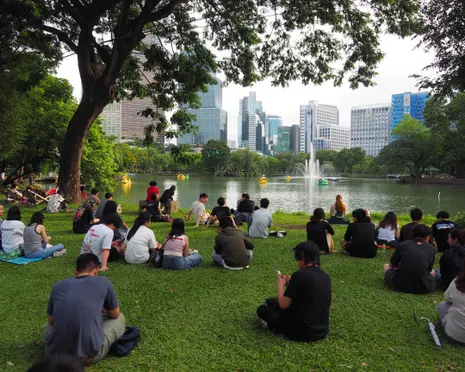
It s good to do nothing – Amidst the relentless pulse of Bangkok—a metropolis where energy flows from towering glass facades down to bustling sidewalks—an unusual invitation emerged last week. The call was simple yet revolutionary: change your rhythm and do absolutely nothing. Hundreds responded, converging upon the verdant heart of the city, Lumphini Park, on July 4th. Participants settled onto colorful beanbags, portable chairs, and woven picnic mats. Some reclined to gaze upward at the clouds, while others positioned themselves facing the tranquil lake. A solitary individual studied a fallen twig with intense focus, several nodded off into light sleep, and remarkably few reached for their mobile devices. Conversation was virtually absent; instead, the atmosphere was filled with avian calls and the soft rustling of ancient monitor lizards navigating the park’s edges.
Global Movement, Local Gathering
The catalyst for this gathering was a Facebook invitation that boldly encouraged attendees to “sit still and do fucking nothing.” Approximately three hundred individuals arrived, motivated by various intentions. Some sought to “escape your screen,” others aimed to “protest capitalism,” and many simply wanted to “spend an hour being completely useless to the country’s GDP.” This phenomenon extends far beyond Thailand. South Korea’s Space Out competition challenges urban populations’ relentless pursuit of productivity and has spread to numerous international cities. Meanwhile, Spain’s Siesta Championship strives to resurrect the nation’s sleeping customs, which modern life has increasingly eroded.
According to Gabrielle Treanor, an author and overthinking coach, technology ensures that contemporary society constantly demands our attention. She noted to the Guardian earlier this year that many people feel burdened by “extra things we feel we ought to be doing.” Despite this awareness, research indicates a widespread discomfort with solitary contemplation. The Bangkok organizers emphasized that participants would receive no guidance whatsoever. There would be no instructions, no countdown timers, no facilitators, no icebreakers, no networking opportunities, no worksheets, and no prescribed learning outcomes.
Voices from the Park
Mint, an HR professional who requested only her nickname be used, expressed curiosity about the concept. “I haven’t heard of an event like this before,” she remarked. Alongside her friend Maple, a psychologist, Mint sought respite from their demanding first year post-graduation. Having relocated from Khon Kaen in northeastern Thailand, Mint observed that Bangkok’s tempo feels considerably more rapid. Consequently, “having a reason to do nothing was nice,” she explained.
Visitors passing through the park, initially drawn by the famous lizards, appeared bewildered by the scene. One observer noted the striking absence of conversation. Aya and Junior, two attendees, anticipated difficulty enduring the full hour but ultimately described the experience as profoundly “free.” They acknowledged that friendship occasionally prompted spontaneous discussion. The event’s organizer, Gun, admitted surprise at the turnout. While recognizing that smartphones serve as “boredom blasters,” Gun hoped participants would rediscover the sensation of quiet boredom—an emotion experts identify as foundational to creativity.
Thailand’s urban corporate culture continues to embrace extended working hours, with Bangkok frequently ranked among cities with the poorest work-life balance. Perhaps this explains why so many embraced the stillness. Some entered deep meditative states, while others appreciated liberation from typical Saturday chores. Pookpick Chayanee found the practice “good for just being with yourself,” noting the hour passed effortlessly. “I love to do nothing,” she affirmed.
Not everyone found the experience effortless. Pompam, a twenty-two-year-old with ADHD, viewed the challenge as particularly demanding. “I’m trying to force myself not to touch my phone, but it’s hard in this generation,” she confessed. She and a companion purchased a paint-by-numbers set to occupy their hands. Tyler attended with friends pursuing master’s degrees, valuing the chance to “chill” without academic pressure. Though uncertain whether his schedule permits regular participation, Tyler concluded simply: “it’s good to do nothing.”