Grief and Resolve at Iran’s Vastest Burial Ground
They made us say he was – Within the sprawling grounds of Behesht-e Zahra, visitors gather to honor those lost during the January demonstrations. The cemetery has become a sanctuary for families seeking closure, each person carrying their own story of loss and determination. Among the many graves, several stand out as symbols of the recent upheaval that shook the nation.
Sepehr’s Eternal Question
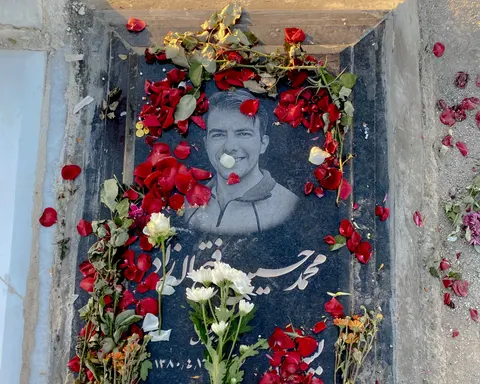
Sepehr, who was twenty-five years old when he fell during the mass street demonstrations, lies beneath a stone bearing a question that echoes through the cemetery. His father captured a moment of raw emotion on his mobile phone in Kahrizak, a town situated near the capital. In that recording, he repeatedly called out:
Sepehr-e Baba, where are you?
This tender Persian expression conveys something deeper than simple address—it carries the weight of a parent speaking to their child.
Today, Sepehr’s name on the gravestone carries those same words. Visitors approach his grave throughout the day, offering brief moments of reflection before departing. Among them stands a mother whose sixteen-year-old son perished during the 2022 women’s rights demonstrations. Sepehr’s father speaks without fear of consequences, his courage born from grief that has transformed into something more resilient. He welcomes cameras and photographs openly, declaring:
I’m waiting for these people to fall. Don’t doubt it – they’re already gone. This regime will not go back to what it was before [January’s crackdown on protesters]. I’m telling all of you this.
Mohammadreza’s Legacy of Kindness
At another section of the cemetery, Mohammadreza rests at age thirty-eight. He died in Tehransar, a district in western Tehran. His sister, with flowing curly hair, and his elderly mother, wearing a pale blue headscarf, visit regularly.
My child had a hard life,
his mother explains.
He didn’t have a good life.
Her words carry complex emotions.
I cursed [Ali] Khamenei,
she continues.
I was very happy when they [US/Israel] killed him. But my heart aches for these children of ours. I wish they had been here, too; they had dreamed of seeing Khamenei gone. There is so much longing in it. I miss my son. We have to endure.
Mohammadreza’s sister describes how his wife now sleeps clutching her husband’s pillow, while their young son visits the grave daily, kissing the stone and weeping.
My brother saved a lot of people the night [he was killed]. He brought everyone into the parking garage. At his funeral, people said: ‘He saved our lives that night.’ He was very kind. He had so much loyalty and honour.
She hopes to inscribe javidnam—Farsi for “everlasting name”—onto his gravestone, though she waits for the atmosphere to settle.
I want to write javidnam on my brother’s gravestone, but we were afraid because they [Iranian police] have broken some of the stones. I’m waiting for a little time to pass, for the atmosphere to calm down. Then I’ll write javidnam on his stone. God willing, by next Nowruz [Iranian new year in March 2027] these pieces of shit will be gone.
Sara’s Final Moment Captured
From a distance, Mohammadreza’s sister points toward Sara’s resting place. Sara was forty-five when she died during the January protests. A viral CCTV recording showed her final moments: alone, unarmed, her terrified eyes fixed upward as plainclothes security forces struck her with machetes. Her large white gravestone bears the word darya—Farsi for “sea”—enclosed in parentheses, representing eternity.
Another woman sits nearby at the grave of her own javidnam.
They killed my cousin [in the protests] and this one [pointing to the grave] a day later. We found my cousin after four days, but we couldn’t find this one. My cousin was killed with bullets; this one with a knife.
She adds:
I wish they had seen Khamenei’s death. Let those bastards go to hell. They will be finished in the end.
Mohammad’s Act of Courage
Mohammad, twenty-eight years old, was killed in Ariya Shahr in north-west Tehran by members of the Basij volunteer paramilitary force. His father and younger brother remain at his grave, both from the capital’s poorer neighborhoods. His brother washes the stone as he recounts the events:
They had grabbed two girls and were dragging them. He went to save the girls, and those bastards hit him instead. He was a boxer. His friends who were with him told us what happened. Four or five Basijis [the Basij is a volunteer paramilitary branch of Iran’s Islamic Revolutionary Guard Corps] had surrounded two girls. My brother and his friends beat the Basijis and helped the girls escape.
These stories, preserved in stone and memory, continue to inspire those who visit. The cemetery has become more than a burial ground—it is a testament to lives cut short and a promise that the fallen will not be forgotten.