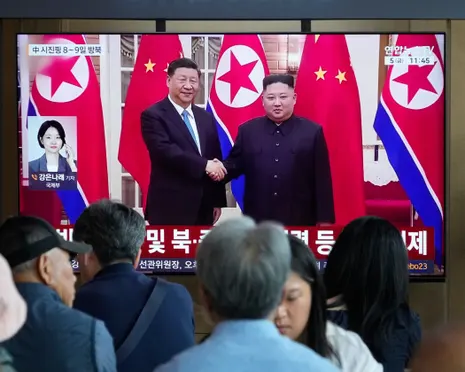
Xi Jinping’s North Korea Visit Signals Strategic Renewal
Wanderstayfinder.com – On Monday, Chinese President Xi Jinping embarked on a two-day trip to North Korea, marking his first visit to the country in nearly seven years. The decision underscores China’s renewed focus on strengthening its alliance with the isolated state, a relationship that has faced challenges in recent years. This visit, which takes place ahead of the 65th anniversary of the China-North Korea friendship and mutual assistance treaty, aims to rekindle diplomatic and economic ties between the two nations.
Historical Roots and Modern Tensions
China and North Korea’s alliance dates back to the Korean War, when their forces fought side by side against South Korea. This shared history forms the foundation of their enduring bond, though the partnership has grown more complex in recent decades. North Korea, China’s sole formal treaty ally, has experienced a cooling in relations with Beijing due to a near-complete halt in trade during the pandemic and its deepening partnership with Russia. Despite these strains, the two countries remain strategically aligned, particularly in matters of regional security.
The current state of their relationship is further complicated by North Korea’s shifting alliances. In 2024, Pyongyang and Moscow formalized a mutual defense pact, significantly bolstering their military collaboration. This has drawn attention to North Korea’s growing reliance on Russia, a development that some analysts argue has weakened its traditional ties with China. John Delury, a senior fellow at the Asia Society, noted that North Korean propaganda often emphasizes the “over the top” celebration of its bond with Russia, which was forged through shared combat in Ukraine. In contrast, China’s engagement with North Korea remains rooted in nostalgia, with Delury suggesting that Beijing seeks to ensure its influence does not wane in the region.
Strategic Balancing Act
Xi’s visit to Pyongyang comes amid a broader effort to navigate the intricate dynamics of global alliances. Last year, Xi and Vladimir Putin stood together in a massive military parade in Beijing, symbolizing the alignment of China and Russia as leaders of a new era of autocratic cooperation. However, behind closed doors, the leaders are working to maintain their distinct interests. For China, this includes preserving a delicate equilibrium with the United States, which it views as a critical partner for trade and security despite recent tensions.
Just weeks prior, US President Donald Trump visited Beijing, where he held a summit with Xi that China framed as a step toward stabilizing their strained relationship. While the meeting yielded limited concrete outcomes, Trump reportedly discussed North Korea with Xi, raising speculation that he may have asked for China’s support in addressing Pyongyang’s nuclear ambitions. Kim Yo-jong, Kim Jong-un’s sister and a powerful figure within the North Korean regime, dismissed these claims as “false,” highlighting the regime’s desire to maintain its independence in foreign policy decisions.
Nuclear Ambitions and Regional Security
North Korea’s recent focus on expanding its nuclear capabilities has intensified its strategic importance to China. Last week, the country unveiled a new nuclear material production facility, signaling its intent to significantly increase its atomic arsenal. Kim Jong-un has called for an “exponential” growth in North Korea’s nuclear program, a move that could challenge the security dynamics of northeast Asia. For Xi, this presents both an opportunity and a challenge: while he aims to reinforce China’s influence over North Korea, he must also address the growing threat he perceives from Japan.
According to reports, Xi became notably animated during discussions with Trump about Japan’s increasing militarism, a concern that has become more pressing as the country enhances its defense capabilities. This sentiment was also echoed in meetings with UK Prime Minister Keir Starmer, who visited Beijing in January. Japan has yet to fully acknowledge China’s characterization of its policies as “new militarism,” though it has faced criticism for its assertive stance in the region. Delury observed that any collaboration between China and North Korea on Japan is likely to remain symbolic rather than substantiated by concrete action.
Global Implications and Future Outlook
The timing of Xi’s visit is also notable for its personal significance. As a leader who has increasingly hosted world leaders in Beijing, this trip represents a rare departure to the field, underscoring the importance of the China-North Korea relationship in the global geopolitical landscape. Analysts suggest that Xi’s presence in Pyongyang is a calculated move to assert his leadership in regional affairs and to demonstrate China’s commitment to maintaining a strong, independent alliance.
William Yang, a senior analyst at the Crisis Group, emphasized that Xi’s decision to visit North Korea directly responds to the country’s recent missile tests, including the successful demonstration of AI-guided weapons. These developments have heightened concerns about the stability of the Korean Peninsula, prompting China to take a more active role in preventing escalation. Yang noted that Xi is keen to “show up in Pyongyang in person” to counter North Korea’s efforts to distance itself from China’s orbit, particularly as the regime seeks to bolster its ties with Russia.
While the immediate goal of the visit is to repair bilateral relations, the broader implications for regional security and global alliances are significant. China’s ability to balance its partnerships with Russia, the United States, and North Korea will be critical in shaping the future of northeast Asia. As Xi strengthens his engagement with Pyongyang, the world watches closely to see how this renewed alliance will influence the ongoing competition for influence in the region.
“In light of North Korea’s recent waves of missile tests, including the announcement of successfully testing AI-guided missiles, Xi likely sees the need to show up in Pyongyang in person to prevent tension on the Korean Peninsula from escalating,” said William Yang, a senior analyst at the Crisis Group.
Xi’s efforts to reinforce China’s strategic foothold in the region are part of a larger geopolitical strategy. By reengaging with North Korea, he not only aims to secure economic and political leverage but also to ensure that the country remains aligned with China’s interests in the face of growing external pressures. The visit serves as a reminder of the enduring, yet fragile, nature of the China-North Korea alliance, which continues to play a pivotal role in shaping the dynamics of northeast Asia and beyond.