A Curious Display: Lightning, Grandeur, and the Quiet Rhetoric of Trump’s Anniversary Address
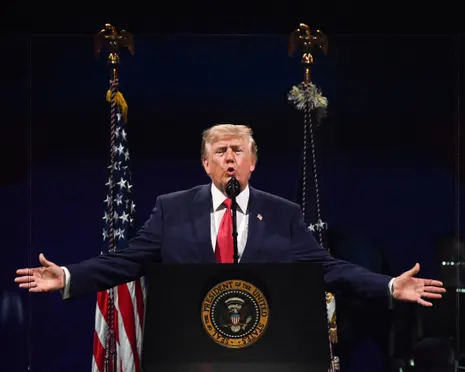
The strangest show on earth – On Saturday night, as the National Mall buzzed with anticipation, Donald Trump took to the podium for a ceremonial speech marking the 250th anniversary of American independence. The event, held under a sky streaked with ominous clouds, was expected to be a spectacle of patriotic fervor. Instead, it became a paradoxical blend of grandiose claims and uninspired delivery, casting a shadow over the celebration. The president, ever the self-proclaimed arbiter of history, seemed determined to carve his name into the narrative of the nation’s founding, even as the weather and his own rhetoric proved unpredictable.
The Storm That Delayed History
As the sun dipped below the horizon, the atmosphere thickened with the promise of thunder. Lightning, striking with the force of a cosmic decree, interrupted the proceedings for four hours. Yet, as if the heavens were simply offering a backdrop, Trump pressed on, unbothered by the interruptions. His team, including chief of staff Susie Wiles, had warned him to stay on script, but the president’s usual bravado carried through despite the chaos. The delay, while disruptive, only seemed to amplify his sense of inevitability.
His advisor Stephen Miller had already framed the event as a divine moment. Posting on social media, he declared that the last decade was proof that “divine providence” had placed Trump in the presidency to coincide with the nation’s 250th birthday. This assertion, though lofty, was met with skepticism by many who saw the speech as a calculated attempt to align his legacy with the founding era. The phrase “the strangest show on earth” was not merely a title—it became a fitting description of the night’s proceedings.
A Rhetorical Back Alley Tour
As the ceremony unfolded, Trump’s speech leaned heavily on familiar themes, weaving together a tapestry of American exceptionalism and personal achievement. The audience, numbering in the hundreds of thousands, was promised a momentous occasion. However, the president’s words betrayed a lack of originality, drifting through the same rhetorical terrain as previous addresses. While he claimed to be the master of the universe, the speech offered little to distinguish it from his usual cadence of assertions and exaggerations.
“For 250 years, the United States of America has been the hope, the promise, the light and the glory among all the nations of the world,” he proclaimed, channeling the imperial hubris of ancient rulers. Yet, this statement was met with a quiet disapproval from the crowd, which had grown accustomed to his bombastic proclamations. The speech’s structure was a disjointed journey, where historical references were used not to illuminate, but to reinforce his own narrative. “All over the world they try to be like us. Nobody can be like us,” he insisted, as if the nation’s unique status was a birthright rather than a hard-won ideal.
“We are going to be better,” Trump declared, his voice rising above the murmurs of the crowd. “With God’s help, we will always be the best, or even better.”
The mention of “E Pluribus Unum”—the phrase etched into the nation’s identity—was delivered with all the gravitas of a ceremonial oath. But the surrounding imagery, a red-and-white arch and blue-lit stages, felt more like a set for a costume drama than a fitting tribute to the founding fathers. The green reflecting pool, which Trump had attempted to rebrand, stood as a farcical reminder of his obsession with visibility and control. Even as the rain poured down, the president remained steadfast, his rhetoric as unyielding as the nation’s constitution.
Exaggerations and the Art of the Aside
Trump’s speech was a masterclass in selective storytelling. He began by recounting the logistical challenges of the day, claiming that the crowd had originally numbered 375,000 before the weather forced a retreat. “They now have 150,000 people,” he said, a figure that seemed as arbitrary as the numbers he had used to inflate his inauguration’s attendance. The audience, still buzzing with the remnants of the storm, listened as the president repeated his mantra of American superiority, even as the numbers he quoted seemed to contradict the scale of the gathering.
When he turned to the nation’s founding, he delivered a dry recitation of the Declaration of Independence, reducing its revolutionary spirit to a list of rights. “They declared that all men are created equal,” he said, “with rights including life, liberty and the pursuit of happiness.” Yet, the next sentence was a clever diversion: “Unlike so many others in the world, in this country we have freedom of speech, freedom of religion, equal justice under the law—although I was not treated that well, but we don’t need to get into that—and the right to keep and bear arms.” The aside, delivered with a hint of sly self-preservation, underscored his tendency to pivot from grand narratives to personal grievances.
A Haphazard Historical Reenactment
One of the speech’s more curious moments came when Trump referenced a historic flag, its story seemingly tied to a naval victory in the 19th century. “It flew atop our flagship after America’s navy sank the Spanish fleet to the bottom of Manila Bay—one of the greatest naval victories in history,” he said, before launching into a comparison with a more recent triumph. “Much like our recent victory sinking the entire Iranian navy: 159 ships to the bottom of the sea, all done in just a moment’s time.” The leap from 19th-century history to modern geopolitics felt abrupt, yet it was emblematic of Trump’s rhetorical style: a patchwork of historical echoes and present-day boasts.
Despite the attempt to ground his speech in national legacy, Trump’s focus remained on his own achievements. The ceremony, meant to honor the past, instead became a platform for his vision of the future. “We want to keep America great,” he promised, “by approving the Save America Act, which means all voters must show voter ID. All voters must provide proof of citizenship. And there will be no mail-in ballots, except for illnesses, disability, military deployment, or travel.” The policy details, though specific, were overshadowed by the grandiosity of the claim. The audience, though largely composed of supporters, could not help but notice the disconnect between the rhetoric and the practicality of the measures.
The Anticlimactic Spectacle
As the sun set and the rain continued, the ceremony reached its peak in a surprisingly muted manner. Trump’s showmanship, often a highlight of his public appearances, seemed subdued. The Teleprompter, a tool he had relied on to navigate the labyrinth of his own words, was present but underutilized. The president, who had once promised to “make America great again,” now seemed to be content with a meandering tribute to the past.
His wife, Melania, joined him on a temporary stage positioned between the Washington Monument and Lincoln Memorial. The design, with its sleek blue lighting and red-and-white arch, was a deliberate attempt to distract from the green pool he had spent years trying to reclaim. The stage was a visual metaphor for his political journey—a temporary construct meant to project permanence. Yet, as the speech progressed, the impact of the scene was lost in the repetition of his familiar themes.
“Happy birthday, everyone!” Trump announced, his voice carrying the same buoyant optimism as his State of the Union addresses. The phrase, though earnest, seemed to fall flat against the backdrop of a ceremony that had already lost its momentum. The audience, waiting in sun, wind, and rain for over 12 hours, was left to ponder the irony of a president who claimed to be the embodiment of American greatness, yet delivered a speech that felt more like a series of disconnected anecdotes than a meaningful reflection.
Even as the ceremony concluded, the lingering question remained: Would this night be remembered as a triumph of American ideals or a testament to the president’s own contradictions? The answer, it seemed, lay in the final moments, where the speeches of veterans and the echoes of the past were drowned out by the repetition of the same rhetoric. The nation’s 250th anniversary, a moment for contemplation, became instead a stage for the president to assert his place in history—a history he seemed content to define on his own terms, even as the world watched with a mix of admiration and bemusement.
In the end, the night’s events underscored a simple truth: Greatness is not always grand. Sometimes, it is a blend of lightning, hubris, and a touch of banality. The speech, while punctuated by flashes of historical reference, ultimately belonged to the president’s own narrative—a narrative that, despite its flaws, remains firmly etched in the public