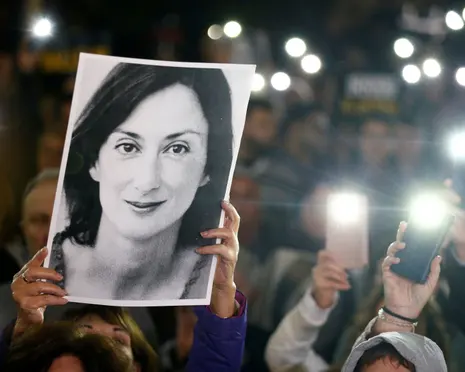
Businessman Linked to Daphne Caruana Galizia’s Murder Funded Hitmen’s Legal Defense, Prosecution Reveals
Maltese Journalist’s Killing Became a Legal Battle Over Financial Responsibility
Man accused of ordering Daphne Caruana – Maltese businessman Yorgen Fenech, facing charges of orchestrating the assassination of investigative journalist Daphne Caruana Galizia, is alleged to have covered the legal expenses of the three men convicted for her murder. Prosecutors presented evidence during Thursday’s trial, indicating that Fenech spent over €400,000 on the defense of the bombers, who were paid to carry out the attack. This financial support, they argue, underscores his direct involvement in the crime, which took place in October 2017.
Fenech, 44, the inheritor of one of Malta’s most influential business empires, arrived at court in an unmarked armored vehicle. He remains under house arrest, having posted a staggering €50 million bail. The trial, now in its second day, has drawn significant attention, not only for the high-profile nature of the case but also for the broader implications of corporate influence in political assassinations. Caruana Galizia, known for her relentless investigations into corruption, was killed in a car bombing that left her family and country reeling.
Prosecutors detailed how the attack was executed with meticulous planning, involving a taxi driver named Melvin Theuma as an intermediary. According to the case presented, Theuma transferred funds to the bombers on Fenech’s behalf, facilitating the payment of €150,000 for the operation. Additional expenses, including €5,000 for logistical costs, were later settled. After their arrest in December 2017, the hitmen reportedly received a larger sum to sustain their legal defense, a detail that has become a central point in the proceedings.
Anthony Vella, the lead prosecutor, emphasized during the opening statement that Fenech’s financial contributions extended beyond the initial payment. “The accused also funded the legal representation of Alfred and George Degiorgio,” Vella stated, highlighting the role of their brother Mario in managing the defense. “Theuma provided over €400,000 to cover these costs, and the police will confirm this through their testimony.” The Degiorgio brothers, who pleaded guilty to voluntary homicide, are currently serving 40 years in prison for their role in the crime.
“Daphne Caruana Galizia was a very active journalist with a strong public profile and many investigations ongoing. They used to describe her as a witch, or ‘just a blogger.’ You may agree with what she wrote or not. That is not what matters here. She was a citizen like us, killed because of her work. What matters is that she was a mother, a person, a daughter, a wife, a sister.”
Vella’s address to the jury focused on humanizing Caruana Galizia, urging them to consider her personal life beyond her professional achievements. The journalist, who had exposed high-level corruption, left behind three sons. Two of them are set to testify during the trial, offering firsthand accounts of the emotional toll her death has taken on the family. The prosecution also plans to present testimony from a neighbor who witnessed the explosion in real-time, adding a vivid account of the moment her life was taken.
“A witness was passing by on the opposite lane. He saw her vehicle explode a few meters away from him. He heard a loud scream. The violent and barbaric way they killed her. In the last seconds of her life, she realized her life was over.”
The bombing, which targeted Caruana Galizia’s car, was described as a calculated act of violence. Prosecutors revealed that the hitmen had taken extra precautions, attaching a container of petrol to the bomb to ensure her death. This detail, combined with the financial backing of her killers, paints a picture of a crime that was both planned and executed with the backing of a powerful individual.
Caruana Galizia’s legacy remains a subject of debate among Maltese citizens. While some celebrate her as a fearless voice against corruption, others have criticized her work, even labeling her as a “witch” or dismissing her as a mere blogger. Vella stressed that these labels are irrelevant to the case, emphasizing the human impact of the crime. “These crimes cause irreparable harm,” he said, reflecting on how her death disrupted her family’s future.
Despite the emotional weight of the case, Fenech has consistently denied the charges, claiming he was not directly involved in the decision to kill. The trial continues, with the prosecution seeking to prove his complicity through financial evidence and testimonies from those close to the incident. The Degiorgio brothers’ guilty pleas have provided a foundation for the case, but the defense may challenge the link between Fenech and the execution of the plot.
The trial has also highlighted the role of political pressure in the journalist’s assassination. Attacks from the ruling party had targeted her, making her a symbol of dissent and accountability. Her death sparked nationwide outrage, with many questioning the motives behind the killing and the power dynamics at play. As the case unfolds, the courtroom has become a stage for a broader discussion about justice, accountability, and the influence of wealth in shaping political outcomes.
Vella concluded his remarks by underscoring the significance of the case for Malta’s judicial system. “This trial is not just about one individual,” he said. “It represents a fight for the integrity of our institutions and the protection of those who dare to challenge the status quo.” The jury is now tasked with weighing the evidence, including the financial support provided to the killers, to determine whether Fenech’s actions were sufficient to warrant a conviction for complicity in murder.
As the trial progresses, the courtroom will likely become a microcosm of the national conversation surrounding Caruana Galizia’s legacy. Her family, who have been left without a mother, continues to advocate for justice, while the public remains divided on her role in Maltese politics. The case may ultimately define how Malta balances the power of its elite with the rights of its citizens, even in the face of tragic consequences.
With the prosecution laying out a compelling narrative of financial complicity, the defense will need to counter these claims effectively. The trial’s outcome could set a precedent for how corporate interests are held accountable in cases involving political violence. As the evidence is presented, the emotional and legal dimensions of the case will continue to intertwine, ensuring that the story of Daphne Caruana Galizia remains at the forefront of the proceedings.