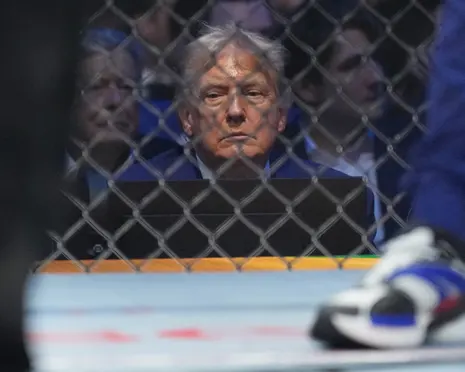
A Far-Right Plot Unveiled: The Attempt to Assassinate Trump at the UFC Event
The UFC match plot – At least eight individuals are now in federal custody after authorities uncovered a coordinated effort to eliminate Donald Trump and other political figures during the Ultimate Fighting Championship event held at the White House. The plot, which was thwarted by the U.S. Department of Justice, involved a network of young activists who merged their ideological fervor with tactical planning. Central to this operation was Tycen Proper, a 19-year-old from a small Ohio town near Amish country, whose life took a dramatic turn after he graduated from high school.
The Origins of a Radical Vision
Proper received a significant financial gift from his family upon completing high school, with court records stating the sum was at least $3,000. However, this money was swiftly allocated toward what would become a pivotal project. His parents noticed his growing detachment from daily life, as he spent increasing hours online and began studying detailed maps of Washington, D.C. “He wasn’t just watching videos—he was analyzing routes and identifying key locations,” his mother later told investigators. This shift in focus led Proper to resign from his job, allowing him to dedicate himself fully to a mission he shared with a group of friends he had connected with through social media.
The conspirators, according to federal documents, utilized a mix of platforms to organize their activities. TikTok served as their initial meeting ground, where they exchanged ideas and bonded over shared grievances. Once their identities were verified, the group transitioned to encrypted messaging services like Signal and SimpleX, where they established a hierarchical structure. Members self-categorized into “tiers” based on their willingness to take risks, with some attending in-person training sessions to refine their strategies.
Planning the Attack
The plan was designed to create chaos during a high-profile event. The plotters intended to stage a public demonstration near the White House to divert attention from their main objective. While Trump and other officials were entertaining fans at the UFC match, the attackers would deploy drone-borne explosives to disrupt the gathering. This would trigger a mass evacuation, during which concealed marksmen would target key political figures. A secondary phase of the operation, as outlined in court filings, involved storming the White House after the initial blast.
“A fucking bloodbath,” one of the alleged conspirators reportedly described the plan to others. This phrase encapsulated the group’s vision of a violent showdown, blending their far-right convictions with a desire to dismantle the current political order.
Despite the scale of the threat, the Trump administration has framed the plot as relatively simple. JD Vance, a Republican senator, remarked last week that the plan “wasn’t that advanced.” He praised the FBI’s efforts but suggested the conspirators had not executed a complex operation. “Thank God we have good law enforcement,” he added, implying that the event was more of an isolated incident than a coordinated attack.
A Fractured Ideology
Interestingly, the group’s targets were not exclusively Democrats. While they were far-right in orientation, their focus on Republican officials—specifically those linked to Israel—highlighted a complex political landscape. Investigators found evidence that the plotters used a leftwing website to identify politicians who had received substantial donations from the American Israel Public Affairs Committee (AIPAC). This tool helped them pinpoint officials they believed were complicit in policies they opposed.
Abraham Alvarez, a 31-year-old alleged ringleader, further complicated the narrative. A documented immigrant from Mexico, his background added an unexpected dimension to the case. The group’s diversity in ethnicity and ideology underscored the broader trend of political extremism, where traditional party lines often blur. Michael Edison Hayden, a journalist specializing in far-right movements, noted that such groups are not always ideologically consistent from the outside, but their goals are clear: to challenge the Republican-led government.
“They’re anti-government, and the government happens to be run by Republicans,” Hayden explained. The plotters’ motivations, according to his analysis, were rooted in a standard anti-elite mindset, infused with antisemitic and accelerationist elements. Proper’s social media posts, which praised Adolf Hitler, exemplified this ideology. Similarly, Michael Alan Thomas, another alleged conspirator, claimed in an affidavit that he believed the U.S. government was controlled by a secretive cabal that had ties to Jeffrey Epstein—a figure central to numerous conspiracy theories about child predators.
The Echoes of Conspiracy Theories
Some conservative media outlets have seized on the case to argue that the plotters were not true far-right activists but rather leftwing extremists. An article in *The Federalist* highlighted how one of the suspects “parroted Democrat conspiracy theories about President Trump protecting child predators connected to Jeffrey Epstein.” This framing, while not entirely accurate, reflects the broader political discourse where conspiracy theories are often weaponized to assign blame.
However, the plot’s ideological coherence is evident when viewed from within its own context. Far-right communities online have long been critical of Trump’s policies, particularly his alliance with Israel. The plotters’ choice to target Republican officials aligns with their broader disdain for what they perceive as an establishment that prioritizes foreign interests over domestic values. This blend of nationalism and anti-establishment sentiment created a unified vision, even if it seemed paradoxical to outsiders.
The incident also reveals the power of social media in radicalizing individuals. Proper’s journey from a high school graduate to a would-be assassin was fueled by online engagement. His parents’ concern over his activities—investing in weapons and body armor—was justified, as the group’s preparations indicated a serious intent to carry out their plan. Their use of encrypted apps to coordinate attacks highlights a growing trend among extremists to operate in secrecy, avoiding detection by mainstream platforms.
Broader Implications
The foiled plot has sparked a national conversation about the reach of far-right extremism. While the event was overshadowed by news of the Iran war and the World Cup, the scale of the threat remains alarming. The group’s ability to organize across state lines and utilize modern technology underscores the potential for large-scale attacks in urban centers. This case serves as a reminder that ideological extremism can manifest in unexpected ways, even at events that are seemingly unrelated to politics.
As the investigation continues, questions linger about the broader network of far-right groups. Many of the individuals involved are in their 20s or early 30s, a demographic often overlooked in discussions about political violence. Their actions, however, suggest that the next generation of activists is increasingly willing to take extreme measures to achieve their goals. The case of Proper and his co-conspirators is not just a story about one event but a reflection of a deeper, evolving movement that seeks to reshape the political landscape through both direct action and ideological influence.