Israel Critics’ Gains Highlight Democratic Divides Over Gaza Conflict
Primary Results Signal Shifting Loyalties in Democratic Party
It s become a litmus test – With the outcome of Tuesday’s primary elections in New York City, a new wave of progressive Democrats is set to enter Congress, driven by their stance on Israel’s actions in Gaza. This development underscores a growing rift within the party, where the issue of whether Israel committed genocide in the region has become a defining factor for voters. The three insurgent victories in the city’s races have reshaped the political landscape, signaling a potential realignment of priorities and loyalties for the Democratic establishment.
Progressive Candidates Challenge Established Power
The primary results saw voters oust two long-standing House Democrats and replace a third, who was retiring, with progressive candidates backed by Zohran Mamdani, New York’s first Muslim mayor. Mamdani, a democratic socialist, has been a vocal critic of U.S. support for Israel, particularly its close ties with the American Israel Public Affairs Committee (Aipac). For decades, Aipac has funneled significant financial resources into Democratic campaigns, ensuring alignment with Israel’s government. However, this year’s elections have exposed a growing discontent among voters, who are now prioritizing candidates who openly oppose Aipac’s influence and the military campaign in Gaza.
Aipac’s Influence Under Scrutiny
Usamah Andrabi, a spokesperson for Justice Democrats, highlighted the shift in voter sentiment during a recent interview. “It’s a testament to how much our movement has evolved,” he said, noting that the group’s efforts to recruit candidates who reject Aipac donations have resonated with a younger, more activist-leaning base. One such candidate was Darializa Avila Chevalier, a doctoral student who narrowly defeated a five-term congressman, Adriano Espaillat, after criticizing his acceptance of Aipac funds. Similarly, in the district represented by retiring Congresswoman Nydia Velázquez, Justice Democrats endorsed Claire Valdez, a state assembly member who secured the Democratic primary over Brooklyn borough president Antonio Reynoso. Valdez’s campaign emphasized her stronger opposition to Israel compared to her rival, reflecting the issue’s central role in local politics.
Genocide Debate Reshapes National Politics
The humanitarian crisis in Gaza, which has claimed over 75,000 lives since October 2023, has become a focal point for Democratic candidates. Following Hamas’s October 7 attack, which killed 1,200 Israelis and took 250 hostage, President Joe Biden’s decision to back Prime Minister Benjamin Netanyahu intensified scrutiny of U.S. involvement. Protesters labeled Biden “Genocide Joe,” a moniker that has persisted as debates over the conflict’s morality have dominated headlines. This controversy has not only affected Biden’s reputation but also influenced the trajectory of Kamala Harris’s presidential campaign, with some analysts suggesting it dampened enthusiasm for her bid.
Primary Campaigns Reflect National Divides
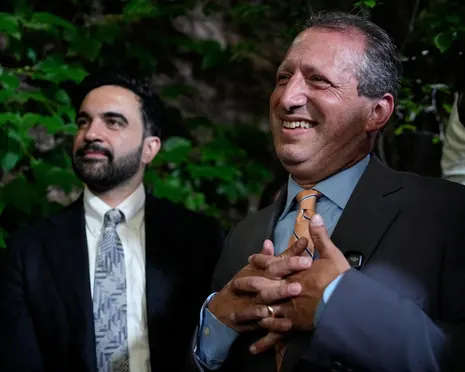
As the midterms approach, the Gaza issue is emerging as a litmus test for Democratic candidates. In one pivotal race, Congressman Dan Goldman faced off against New York comptroller Brad Lander, with Goldman attempting to downplay the conflict’s significance to his district. During a debate, he argued that the term “occupation” was overly charged and that the campaign did not qualify as genocide. Lander, however, positioned himself as a bold advocate for Palestinian human rights, criticizing the U.S. strategy of supporting Israeli leaders like Netanyahu. “Our party must confront the reality of its stance on Israel and Palestine,” Lander stated in his victory speech, emphasizing the moral stakes of the issue.
Supporters Align with Progressive Messaging
Manny Fidel, a Brooklyn-based writer, echoed this sentiment, stating that the Gaza conflict was the “big issue of this race.” He praised Lander’s clear-headed approach to the topic, contrasting it with Goldman’s more moderate stance. “I chose Brad because of his firm views on Israel and Palestine,” Fidel said, suggesting that the issue is becoming a key differentiator in national elections. Meanwhile, Corbin Trent, a former aide to Democratic Congresswoman Alexandria Ocasio-Cortez, pointed to the broader implications of these primary results. “This reflects a growing demand for accountability,” Trent remarked, adding that the Democratic Party’s internal divisions over the conflict are now more visible than ever.
Implications for the Midterm Elections
The wave of progressive victories in New York has sent ripples through the Democratic Party, raising questions about its ability to unify in the face of ideological divides. With the midterms just months away, the party faces the challenge of balancing its base’s demands with the need to appeal to moderate voters. The Gaza issue, once a secondary concern, now looms large, shaping not just local races but also national strategy. As Democrats prepare to take on Republicans in November, the question of how they will address Israel’s actions will be critical to their success.
While the conflict in Gaza has brought international attention, it also has a domestic impact. The Genocide Joe label has become a rallying cry for critics of Biden’s policies, but it has also sparked debates within the party about the appropriate level of U.S. involvement. Some argue that the focus on the Gaza conflict has overshadowed other pressing issues, such as healthcare, climate change, and economic inequality. However, others contend that the moral imperative of opposing genocide is a necessary component of Democratic identity.
The role of Aipac in funding candidates who support Israel has long been a point of contention. Justice Democrats and other progressive groups have worked to counter this influence by promoting candidates who reject Aipac donations and advocate for a more balanced approach to the conflict. This strategy has paid off in New York, where the electorate has shown a clear preference for voices that challenge the status quo. As the Democratic Party navigates this new terrain, it must address the concerns of both its base and the broader electorate to avoid further fragmentation.
A Continuing Challenge for Democratic Unity
Despite the progress made by progressive candidates, the road to unity remains difficult. The Genocide Joe label has not only affected Biden’s standing but also created a sense of urgency for the party to redefine its position on Israel. In his victory speech, Lander called for a more decisive approach, urging Democrats to “admit that Joe Biden’s hug-Bibi strategy was a catastrophic failure.” His remarks highlight the pressure on the party to reconcile its international commitments with domestic values, particularly in a country where support for Israel is often seen as a marker of patriotism.
As the November midterms draw closer, the outcomes of New York’s primaries may serve as a model for other races. The victory of candidates who openly oppose Aipac and advocate for Palestinian rights suggests that the Democratic base is increasingly willing to prioritize moral clarity over political expediency. However, this shift also risks alienating voters who view strong support for Israel as essential to national security. The challenge for Democrats will be to craft a message that resonates with both progressive activists and moderate constituents, ensuring that the party can present a cohesive front against the Republicans.
Ultimately, the Gaza issue has transformed from a peripheral concern into a central pillar of Democratic identity. The fact that it has become a litmus test for the party’s left wing indicates a broader cultural and political realignment. As candidates like Lander and Valdez gain momentum, their success may pave the way for a new era of Democratic leadership—one that is more willing to challenge the status quo and prioritize the voices of those who demand accountability for the actions of the United States in the region.