France Records Hottest Day Ever as 40 Drownings Linked to Heatwave
France records hottest day ever as 40 – On June 23, 2026, France set a new national temperature record, with the mercury climbing to 44.3°C in Pissos, Landes, according to Météo-France. This extreme heatwave has also been associated with a spike in drownings, as 40 individuals were confirmed to have died in unsupervised water areas over recent days. Prime Minister Sébastien Lecornu described the situation as a “tragic scourge of drownings,” noting that the majority of victims were young people. The crisis has prompted officials to convene an emergency meeting to address the escalating situation.
A Heatwave That Shatters Records
The heatwave, which has gripped much of western France, has pushed temperature readings beyond historical norms. Lecornu emphasized that the event is “exceptional in intensity,” with records being broken daily and nightly. Météo-France reported that Tuesday’s temperatures reached a record 29.8°C, surpassing the previous high of 29.4°C, last seen during the 2003 and 2019 heatwaves. The agency highlighted that cities like Bordeaux, where temperatures hit 42.1°C, are experiencing unprecedented conditions even for the month of June.
“Every day and every night, local and national temperature records are being broken,” Lecornu stated, underscoring the severity of the crisis. “We’re facing an episode that’s both relentless and extreme.”
The national weather service has also issued warnings about overnight heat, which reached record levels. This has led to a widespread impact, with 54 departments under a red alert for the oppressive conditions. The heat is described as “oppressive and exhausting,” creating a challenge for both residents and infrastructure.
Impact on Tourism and Public Spaces
Two iconic landmarks, the Eiffel Tower and the Louvre, have taken measures to protect visitors from the scorching weather. The Eiffel Tower’s operator announced an “exceptional closure” on Tuesday at 4pm, more than eight hours earlier than usual, and warned of potential repeat actions on Wednesday. The Louvre, meanwhile, will close two hours early from Wednesday to Saturday, citing vulnerability due to heat buildup and high foot traffic. “Although parts of its historic building are naturally resilient, the museum is not sufficiently adapted to climate change,” the Louvre’s management explained.
France’s national heat index, calculated from data collected at 30 weather stations, hit an all-time high of 29.8°C, according to Météo-France. This figure is expected to be finalized soon, but it already signals a dramatic shift in weather patterns. The previous record of 29.4°C was achieved during the intense heatwaves of August 2003 and July 2019, yet the current conditions are even more extreme.
Heatwave-Related Advisories and Infrastructure Strain
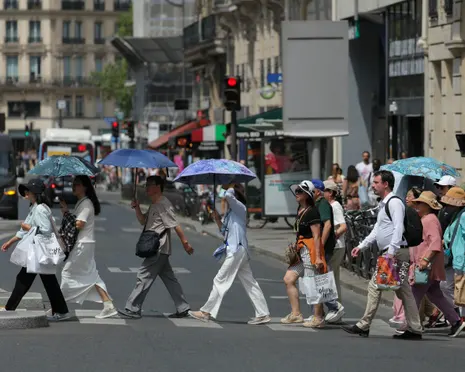
In response to the crisis, authorities in the Île-de-France region, which includes Paris, have urged people to work from home and avoid long train journeys. “Transport networks face severe strain during extreme heat,” said Valérie Pécresse, the region’s head. “Railways cannot withstand temperatures exceeding 50°C.” This advisory reflects the broader challenge posed by the heatwave, which has already led to school closures and disruptions in daily life.
Meanwhile, the Golfech nuclear plant in southwestern France temporarily shut down a reactor after cooling water from a nearby river exceeded the safe threshold of 28°C. This incident highlights the cascading effects of the heat, as even critical infrastructure must adapt to extreme conditions. The heatwave’s duration is expected to extend through the week, with forecasts suggesting further record-breaking temperatures.
European Heatwave and Climate Connections
The scorching temperatures are not confined to France. Across Europe, a similar heatwave has been observed, with the climate scientist Clair Barnes of Imperial College London attributing it to a “bulging mass of hot air.” “This mass is drawing warm air from the Sahara and North Africa, creating a stagnation that offers no respite,” Barnes explained to Reuters. “The lack of wind exacerbates the heat, making it feel even more intense.”
“It’s very slow moving and means there’s kind of no wind, no breeze for respite,” Barnes added, linking the phenomenon to climate change patterns. “This is a clear example of how global warming is altering weather systems.”
In Italy, the health minister has declared a red heatwave alert in 15 cities, including Milan and Rome. The surge in air-conditioning use has also led to power outages, particularly in Milan, where blackouts were reported. This situation underscores the interconnectedness of the climate and energy crises, as demand for cooling increases strain on power grids.
As the heatwave continues, its effects are becoming more pronounced. In England, some schools closed early on Tuesday as the UK prepared for potential new temperature records. The Met Office issued its second red warning for the week, with temperatures expected to reach 40°C. This has sparked concerns about the long-term implications of such events, especially in the context of global warming.
“London isn’t just calling. It’s cooking,” said UN Secretary-General António Guterres at a Climate Action Week event. “A climate crisis is pushing us deeper towards higher temperatures and closer to catastrophic tipping points. An energy crisis is exposing the folly of a world reliant on hydrocarbons. These crises share the same destructive origin: fossil fuels.”
While the immediate focus remains on France, the heatwave is a stark reminder of the broader challenges facing Europe. The interconnected nature of the climate and energy crises is evident, with rising temperatures driving up energy demand and straining systems. As the heat persists, officials and experts are warning of the need for urgent action to mitigate its impacts, from public safety measures to infrastructure upgrades and energy policy reforms. The week ahead will likely see more records set, further testing the resilience of communities and ecosystems across the continent.