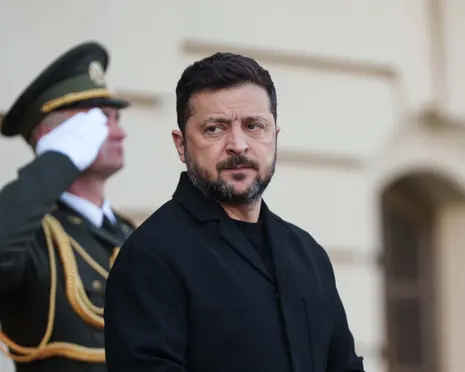
Volodymyr Zelenskyy to Skip Postwar Conference Amid Tensions with Poland
Volodymyr Zelenskyy to skip postwar conference – President Volodymyr Zelenskyy has decided not to attend the Ukraine Recovery Conference, scheduled to begin in Gdańsk, Poland, on Thursday. This move comes amid escalating disagreements with Warsaw over the naming of a military unit in honor of the Ukrainian Insurgent Army, or UPA. Zelenskyy’s absence will be replaced by Prime Minister Yulia Svyrydenko, marking a shift in the leadership of the event. The annual gathering, traditionally held in cities such as Rome, Berlin, and London, aims to unite international partners and businesses in supporting Ukraine’s reconstruction efforts following the war.
A Historical Dispute
The conflict centers on how Ukraine perceives its wartime history. Zelenskyy’s decision to name a unit after the UPA, a partisan group that fought for independence from the Soviet Union, is seen in Kyiv as a tribute to national heroism. However, in Poland, the UPA is remembered for its role in the Volhynia massacres, during which it is estimated to have killed as many as 100,000 Poles between 1943 and 1945. This act, part of a broader campaign to clear the region of Polish inhabitants, has left a lasting scar on Polish-Ukrainian relations.
The Volhynia region, which has changed hands multiple times throughout the 20th century, is now part of modern-day Ukraine. After being occupied by both Soviet and Nazi forces, the area became a battleground for ethnic and political tensions. The UPA’s actions during this period, aimed at securing Ukrainian territory, are viewed in Poland as a genocidal effort, a stance that gained formal recognition in 2016 when the Polish parliament unanimously passed a motion labeling the killings as a “genocide committed by Ukrainian nationalists.” Historians note that Polish underground forces retaliated by killing around 10,000 Ukrainians, further complicating the historical narrative.
Political Fallout
Zelenskyy’s decision to honor the UPA has sparked outrage in Poland, particularly among conservative circles. Karol Nawrocki, the country’s conservative president and former head of the Institute of National Remembrance, expressed his frustration, calling Zelenskyy’s choice “outrageous.” Nawrocki suggested that the president might lose Poland’s highest civilian honor, the Order of the White Eagle, which was awarded to him in 2023. The revocation of this title has become a focal point of the dispute, symbolizing a deeper rift over historical interpretations.
“Ultimately, the position of the Ukrainian side did not change. History should not be an obstacle to the future, but a good future can only be built on truth,” said Nawrocki’s chief foreign policy adviser, Marcin Przydacz. “If anyone wants to be proud of the murderers of women and children, they cannot be surprised by the reaction.”
Despite weeks of behind-the-scenes negotiations between Kyiv and Warsaw, no consensus has been reached on the naming issue. Both sides have blamed each other for the stalemate, with no compromise emerging. Zelenskyy’s predecessors, including Leonid Kuchma, Viktor Yushchenko, and Petro Poroshenko, have also taken similar steps, returning their Polish honors in solidarity with the current president. This collective gesture underscores the depth of the historical dispute and its political weight.
The decision to skip the conference has left Poland’s pro-European Prime Minister Donald Tusk in a difficult position. As the main host of the event in his hometown of Gdańsk, Tusk has long advocated for improved relations between Ukraine and Poland. He previously warned that a worsening of tensions between the two leaders would be “a strategic mistake that will cost both sides.” However, Tusk acknowledged the existence of anti-Ukrainian sentiment, calling it “sometimes justified,” while accusing politicians in both nations of fueling divisions rather than fostering unity.
Zelenskyy’s Defense
In response to the criticism, Zelenskyy defended his choice, stating that the UPA’s designation was a reflection of the military’s pride in their units. “Our service members choose a heroic name for their unit themselves, and as president and supreme commander-in-chief, I must support them,” he argued. The president also emphasized that the dispute risks weakening Poland-Ukraine ties at a critical moment, as both nations face heightened challenges from Russia.
On Friday, Nawrocki confirmed that he would revoke the Order of the White Eagle from Zelenskyy, a symbolic act of protest. Meanwhile, Zelenskyy took a more direct approach, sending the award back by post. He accused Nawrocki of using the controversy to inflame nationalist sentiments ahead of Poland’s upcoming parliamentary elections, drawing parallels to Hungary’s former prime minister, Viktor Orbán, who has similarly leveraged historical narratives for political gain.
A recent poll conducted by Polish media revealed that a majority of Poles supported Nawrocki’s stance, reflecting the nation’s strong emotional ties to its wartime history. For Zelenskyy, however, the issue is about recognizing the sacrifices of Ukrainian forces during the fight for independence. He framed the naming of the unit as an act of historical commemoration, rather than an attack on Poland’s memory.
Strategic Implications
The standoff highlights the delicate balance between historical truth and political diplomacy. While Zelenskyy insists that the UPA deserves recognition for its role in defending Ukrainian sovereignty, Poland views the honor as an affront to its victims. This disagreement threatens to overshadow the conference’s goal of fostering international support for Ukraine’s recovery. Tusk, who has long emphasized the importance of collaboration, now faces the challenge of mediating between two leaders whose positions have grown increasingly entrenched.
As the conference unfolds, the absence of Zelenskyy will serve as a reminder of the unresolved tensions between the two nations. The event, meant to strengthen alliances and secure funding, may struggle to achieve its objectives without the Ukrainian president’s presence. Meanwhile, the historical dispute continues to shape public opinion and political strategies, with both countries using the conflict to advance their narratives. The question remains: can history be a bridge, or will it become a barrier to future cooperation?
With the Order of the White Eagle revoked and the conference’s political dynamics altered, the dispute over the UPA is likely to linger as a defining issue in Polish-Ukrainian relations. Whether this conflict will lead to lasting damage or serve as a catalyst for deeper dialogue remains to be seen. As the world watches the unfolding tensions, the stakes are not just about the past but about the future of a partnership that has been pivotal in the face of global threats.