Fashion Tycoon Bernard Arnault Accused of Stranglehold Over French Business Press
Wanderstayfinder.com – At the helm of the world’s most prestigious luxury conglomerate, Bernard Arnault has long been a symbol of opulence and influence. His empire, LVMH, encompasses a vast array of high-end brands, from the iconic Louis Vuitton to the refined Dior and the sparkling Tiffany, amassing a fortune that Forbes estimates at approximately $145bn (£108bn). Yet, this titan of fashion and finance is now facing scrutiny from French journalists’ unions, who allege that his media acquisitions have granted him an overwhelming grip on the nation’s business press.
Central to the controversy is the purchase of *Challenges*, a centrist business weekly, by LVMH. Reporters Without Borders has raised concerns, stating that Arnault’s control over key publications like *Les Echos* and *L’Agefi* has created a “stranglehold” on the media landscape. These outlets, which once served as independent platforms for economic discourse, now operate under the shadow of his conglomerate. The union’s complaints argue that the acquisition stifles diverse viewpoints, concentrating power in a single entity. Meanwhile, France’s council of state is reviewing whether regulatory oversight was adequate during the transaction, while the competition watchdog assesses claims that LVMH has “abused its dominant position” in the market.
“This is a textbook example of the loopholes in French law which fail to keep media ownership in check,” said Laure Chauvel, head of the France-Italy desk at Reporters Without Borders.
Arnault’s media portfolio extends beyond *Challenges*. He also owns *Le Parisien*, a daily newspaper, and *Paris Match*, a celebrity magazine, further intertwining his influence across cultural and economic spheres. In 2022, he defended his strategy before a senate committee, asserting that his media investments were driven by a desire to safeguard essential titles and maintain their vitality. However, critics see this as a calculated move to shape public narrative, especially as the country prepares for the presidential election in spring 2026.
Amid Arnault’s expansion, other billionaires are also consolidating their media empires. Vincent Bolloré, a conservative industrialist, has been accused of leveraging his media holdings—including the TV channel CNews—to amplify far-right ideologies. His empire spans book publishing, film production, and digital platforms, prompting backlash from writers and film professionals. Despite petitions demanding reform, Bolloré has dismissed critics, framing himself as a Christian democrat. Similarly, Daniel Křetínský, a Czech energy magnate who owns the UK’s Royal Mail, is expanding his reach into French media, further complicating the landscape of ownership.
Xavier Niel, another influential figure, has a unique connection to Arnault’s world. His partner is the CEO of Christian Dior Couture, and his daughter, Delphine, previously held a stake in *Le Monde*, France’s leading newspaper. Niel’s media ventures include *BFM TV*, a rolling news channel, and *La Provence*, a Marseille-based daily. Meanwhile, the Dassault family, known for their defense company *Dassault Aviation*, owns *Le Figaro*, a historic daily newspaper. While their media holdings are smaller compared to Arnault’s, they underscore the broader trend of billionaire-driven consolidation in France.
The accusations against Arnault are part of a larger debate over the concentration of media power in the hands of a few wealthy individuals. As Emmanuel Macron’s two terms draw to a close, political tensions are rising, and the far right has gained momentum. With the presidential election approaching, the role of media in shaping public opinion has become a focal point. Arnault’s control over business publications is seen as a potential tool to influence the discourse, particularly on economic and political issues.
Arnault’s media strategy has roots in his early career. Born into an industrial family in Roubaix, northern France, he initially worked in construction and real estate before pivoting to the fashion industry. A pivotal moment came in 1984 when he lobbied the French government to rescue Boussac, a near-bankrupt textile company. This move allowed him to acquire the Christian Dior brand, which became the foundation of his luxury empire. Over decades, LVMH has grown through strategic acquisitions, solidifying its position as the globe’s most valuable luxury group.
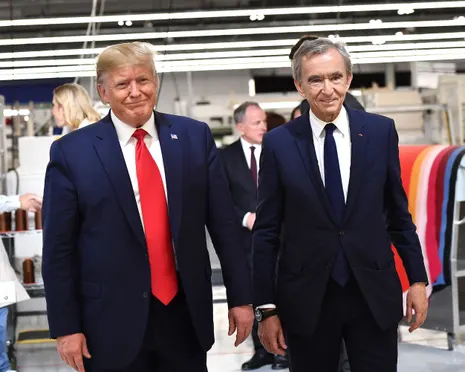
His political leanings have also played a role in his media approach. Arnault has consistently opposed wealth taxes, a stance that aligns with his vision of minimal government interference in business. This philosophy was evident during his brief stint in the United States in the early 1980s, when he fled France to escape what he perceived as a hostile environment for entrepreneurs. There, he formed a close bond with Donald Trump, a relationship that has endured over the years. Arnault, his wife, and two of his children were the sole French attendees at Trump’s second inauguration in January 2023, a gesture that highlighted his political alignment with the American right.
While Arnault’s media acquisitions have drawn criticism, they also reflect a broader pattern of wealth-driven influence in French society. The rise of media empires by billionaires has sparked debates about the independence of news and the potential for biased reporting. For instance, *La Tribune*, a former business paper now rebranded as an online publication, was once under Arnault’s control. In April 2025, its staff went on strike, fearing the decline of traditional journalism as the company shifts focus to digital platforms. This incident has intensified calls for transparency in media ownership, with some arguing that Arnault’s dominance could skew public perception of economic and political events.
The question remains whether Arnault’s actions are beneficial or detrimental to France’s media landscape. While he claims to protect vital publications, the critics assert that his acquisitions have created a monopoly, limiting voices that challenge his narrative. As the country’s business press becomes increasingly aligned with his interests, the debate over media freedom and ownership continues to gain traction. For now, LVMH stands as the largest player in this game, with its vast influence extending far beyond the world of luxury.
Despite the controversy, Arnault has remained unapologetic. His recent statements, such as describing his media investments as “in the general interest,” suggest a belief in his ability to balance economic and cultural priorities. Yet, with the stakes of the upcoming election mounting, his role as a media magnate may become more significant than ever. Whether his influence is seen as a stabilizing force or a threat to pluralism will likely shape the next chapter of French media history.