
A Decades-Old Luger Surfaces in Lake Annecy, Reigniting France’s Most Notorious Cold Case
Wanderstayfinder.com – Fourteen years after four people were gunned down on a quiet Alpine road, a pistol pulled from the waters of Lake Annecy has sent investigators back to a case that has resisted solution since September 2012. Two tourists, believed to be British, discovered the semi-automatic weapon while swimming roughly five feet below the surface, a short distance from the lake’s shoreline. The find, confirmed by French prosecutor Marie-Céline Lawrysz, is now undergoing ballistics examination in connection with the al-Hilli murders — one of the longest-running unsolved killings in recent French criminal history.
The 2012 Attack
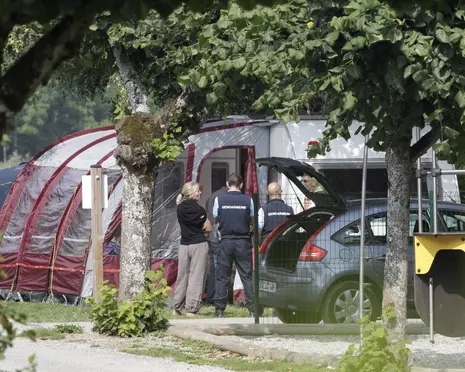
The tragedy unfolded on September 5, 2012, on a stretch of road near the village of Chevaline, close to Annecy in eastern France. Saad al-Hilli, aged 50, his wife Ikbal, 47, and her mother Suhaila al-Allaf, 74, were shot dead. Their two daughters, then just four and seven years old, survived the attack. A passing cyclist, 45-year-old Sylvain Mollier, was also struck and killed. The family had been travelling in a British-registered BMW estate car when the shooting took place.
In the aftermath, investigators recovered fragments from the rear of the weapon used — identified as a vintage Luger P06-29, a model once issued to the Swiss army in the 1930s. Those pieces lay scattered on the ground beside the crashed vehicle. Despite years of searching, the pistol’s owner was never identified, and the case slipped into France’s cold-case files.
The Lake Discovery
On August 20, 2026, the two swimmers retrieved the pistol from the lake. Rather than surrendering it immediately, they retained the weapon for a full day, conducting online research to determine its make and model. That research led them to draw a connection between the recovered firearm and the one believed to have been used in the Chevaline killings.
Lawrysz outlined the sequence of events in a formal statement:
“They kept the weapon for 24 hours and conducted online research to identify its type. They subsequently drew a link between the discovered weapon and the one believed to have been used in the Chevaline [near Annecy] killing on September 5, 2012. On August 21 2026, they handed the weapon over to gendarmes from the local Saint-Jorioz brigade.”
The pistol is now in the hands of French ballistics specialists, who will compare its serial markings, chamber dimensions, and any residual residue against evidence preserved from the original crime scene. If the weapon proves to be the very one that fired the fatal shots, it would represent the most significant physical breakthrough in the case since its inception.
A Long Trail of Dead Ends
The al-Hilli investigation has consumed considerable resources over more than a decade. Detectives have systematically pursued and discarded numerous leads. Early in the inquiry, authorities explored the possibility of a contract killing, ultimately ruling it out on the reasoning that a professional assassin would not have selected a decades-old military sidearm for the job.
Among those previously detained was an Iraqi prisoner referred to in court documents as Mr S, who was alleged to have stated he had been offered “a large sum of money” to eliminate Iraqis residing in Britain. Saad al-Hilli’s brother, Zaid, was arrested in 2013 on suspicion of murder but was subsequently informed that no further action would be taken after police concluded the evidence was insufficient to support a charge. In 2022, yet another suspect was questioned and released without prosecution.
More recently, detectives attached to France’s dedicated cold-case unit ordered DNA analysis on clothing worn by the victims, on the recovered fragments of the original gun, and on cigarette butts collected at the scene. Those tests, completed roughly two years ago, yielded no actionable results and produced no arrests.
Why the Case Has Not Closed
The al-Hilli murders occupy a peculiar place in French criminal memory. The victims were ordinary residents of the United Kingdom visiting the Alps; the location was remote; and the weapon, a relic of interwar Swiss military procurement, pointed toward no obvious suspect pool. The absence of a clear motive, combined with the small number of witnesses, has left investigators without a conventional investigative anchor.
The current ballistics examination of the lake-recovered pistol introduces a variable that earlier inquiries lacked: the possibility of matching a complete firearm to scene evidence. Should the analysis confirm a link, prosecutors would gain a tangible object to interrogate — one that may carry tool marks, microscopic metal transfer, or serial-number traces capable of identifying its last registered owner. For the two surviving daughters, now teenagers, and for the families of all four victims, the prospect of closure after fourteen years of unanswered questions makes this development the most consequential development in the case since the night of September 5, 2012.
Related Reading
Frequently Asked Questions
What is Gun found in French lake is analysed?
Gun found in French lake is analysed is the main topic of this guide. The article explains the context, practical details, and next steps readers should understand.
Why does Gun found in French lake is analysed matter?
Gun found in French lake is analysed matters because readers are looking for a useful answer, not just a short summary. Good content should match search intent and help them decide what to do next.