‘The birds will fly away’: can Albania’s flamingo revolution keep its wetlands free from Trumps and tourists?
Wanderstayfinder.com – Amid escalating tensions over development and conservation, a once-pristine stretch of Albania’s natural heritage faces a potential transformation into a luxury resort. The proposed project, backed by a prominent political family, threatens to engulf sections of the nature reserve teeming with wildlife, including thousands of pink flamingos that have become a symbol of the region’s ecological value. While the idea of a high-end hotel complex has gained traction, it has also ignited fierce opposition from environmentalists, locals, and even international observers.
A Fragile Ecosystem Under Threat
The Vjosa River delta, a mosaic of marshes, dunes, lagoons, and salt pans, has long been a haven for biodiversity. Declared Europe’s first wild river national park in 2023, this dynamic landscape hosts 12% of Albania’s wintering waterbirds and serves as a critical stopover for migratory species. Among its most striking features are the vibrant pink flamingos, whose presence adds a surreal aesthetic to the blue shallows. Yet, as machinery begins to encroach on these areas, the dream of preserving them appears increasingly fragile.
Experts warn that the proposed development could irreversibly alter the delta’s delicate balance. Aleko Miho, a biologist at the University of Tirana, highlights the urgency of protecting these habitats. “These are important habitats. It doesn’t matter who is behind it. What matters is the pressure it puts on a protected area,” he explains. His annual surveys reveal that 279 of the 2,529 species within the delta are classified as internationally threatened, underscoring the area’s ecological significance.
The conflict has roots in the government’s decision to redraw the boundaries of the Pishë Poro–Nartë protected area in 2022. This move paved the way for the construction of Vlora airport, a project that had hoped to launch its first commercial flight this month but still awaits an operating permit. In 2024, the amendment to conservation laws further loosened restrictions, allowing five-star hotels to be built even within designated wildlife reserves. These changes have drawn sharp criticism from environmental groups, who argue they signal a growing disregard for nature in favor of economic gain.
The Trumps’ Ambitious Vision
At the center of the controversy is the Trump family’s real estate ambitions. Ivanka Trump, a key figure in the project, expressed admiration for the site during a visit to Sazan Island. “It’s not even a business for me, despite the scale of it,” she told podcast host David Senra, describing her plans as a “culmination of all of my experience in real estate, all of my travel, and a lot of reflection on how I want to live.” Her vision includes a vast resort complex, with the promise of luxury and modern amenities.
However, the project’s rapid pace has raised concerns. Machines have already begun clearing the Pishë Poro–Nartë area, a key part of the Vjosa-Narta protected landscape. While the government claims the work is for technical surveys and environmental measurements, critics argue it marks the first step toward full-scale construction. “In the meantime, the bulldozers are really progressing,” says Aleksandër Trajçe, executive director of PPNEA, Albania’s largest conservation group. “They’re destroying the dunes. They’re opening new roads. The area has been fenced off … it’s really a wild west situation.”
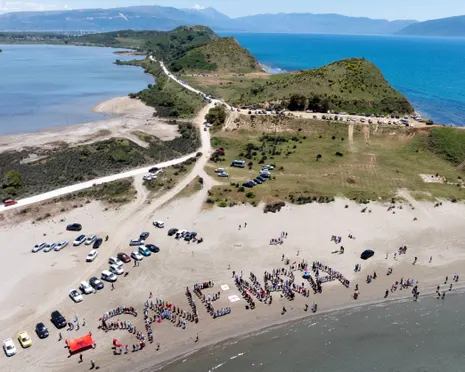
Locals and conservationists have mobilized in response, staging nearly two weeks of protests against what they see as a reckless exploitation of natural resources. The unrest has been fueled by both domestic frustration with government corruption and global attention to the Trump family’s business dealings. Trajçe emphasizes that the protected area’s designation as a wildlife sanctuary was “something that amid all of this probably gets forgotten, but it’s what sparked the big outrage.” For him, the delta represents a rare chance to preserve the Mediterranean’s original wildness before it is overwhelmed by tourism.
A Nation’s Struggle Between Progress and Preservation
Albania, one of Europe’s poorest countries, has long grappled with the tension between economic development and environmental conservation. The nation’s push to attract tourists has seen record-breaking numbers, with 12 million visitors recorded in 2025 alone. Yet this influx has come at a cost, as the government prioritizes short-term gains over long-term ecological sustainability.
The Vjosa River delta, with its untamed beauty, has become a focal point in this struggle. Its status as a protected area was meant to safeguard its unique ecosystems, but recent policy shifts suggest otherwise. The 2024 amendment to environmental laws, which allows construction in wildlife reserves, has been criticized as a compromise that weakens conservation efforts. “The government has shown a clear willingness to adapt regulations to suit large-scale projects,” says Trajçe. “This is not just about one site—it’s a pattern that threatens the entire region.”
The European Commission has also weighed in, urging Albania to “act without delay” to meet environmental standards as it seeks EU membership by 2030. On the same day it issued this warning, 96 civil society organizations petitioned the Albanian parliament to repeal the 2024 amendment. They argue that the law’s revisions could jeopardize the country’s bid to join the EU, which requires stricter environmental protections.
For now, the fate of the delta remains uncertain. While the government has welcomed the Trumps’ vision, the lack of public consultation and environmental impact assessments has sparked calls for transparency. Trajçe fears that without intervention, the area’s natural splendor will give way to concrete and steel. “If the birds will fly away, what will remain?” he asks. “The delta is not just a place—it’s a living testament to the Mediterranean’s wild soul.”
The Flamingo Sanctuary as a Symbol of Resistance
The flamingos, with their striking pink hues and graceful movements, have become an emblem of the fight to protect the delta. Their presence in the shallows is a reminder of the area’s untouched beauty, yet their habitat is under threat. Conservationists warn that the construction of a luxury resort could disrupt the delicate food chain that sustains these birds, as well as the otters, sea turtles, dolphins, and water frogs that call the delta home.
Environmental groups argue that the project represents a broader trend in Albania: the encroachment of urbanization and tourism into natural spaces. The Vjosa River, which flows freely through the delta, is a lifeline for countless species, but its banks are now being eyed for development. Trajçe points to the 2022 boundary changes as a precursor to this exploitation, which he believes has set the stage for further environmental degradation.
Despite the opposition, the Trumps’ plan continues to gain momentum. The government’s support for the project has been unwavering, with officials downplaying concerns about its ecological impact. “We’re not just building a resort—we’re creating jobs and boosting the economy,” one minister stated. But for Trajçe and others, the loss of the delta’s biodiversity is a more pressing issue. “This is one of the last, if not the last, spots where you can see the Mediterranean as it used to be,” he says, invoking the memory of a landscape unspoiled by human interference.
As the debate intensifies, the question remains: can Albania balance its need for economic growth with the imperative to protect its natural wonders? The answer may hinge on the actions of the government and the resolve of its citizens. For now, the flamingos stand as a silent but powerful reminder of what is at stake—a symbol of a world that could soon be lost to the march of progress.
In the end, the delta’s fate reflects a larger struggle. It is a microcosm of the global conflict between development and conservation, where the lure of luxury and profit often overshadows the value of untouched wilderness. Whether the project will succeed or fail depends on how Albania chooses to define its future. Will it prioritize the pink blush of flamingos or the towering structures of a resort?